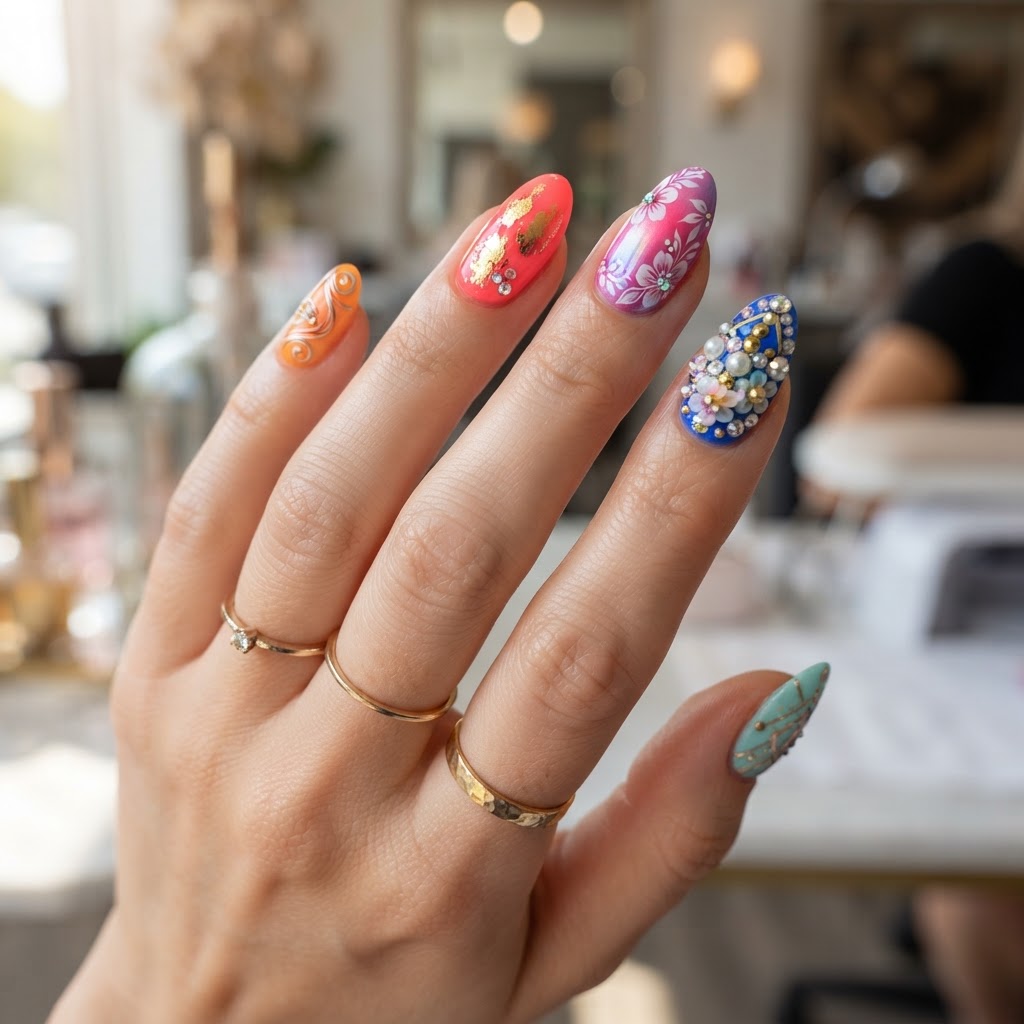
Nail Art Is Back: The Designs Clients Are Screenshotting Right Now
By Nail Tech Success Team
The Return of Nail Art — But Different
For the last couple of years, "quiet luxury" has dominated nails — milky whites, chrome glazes, barely-there sheer pinks. And that's still going strong.
But alongside it, nail art is back. Not the full-cover rhinestone explosions of the 2010s — this is a more refined, more considered kind of art. Smaller, more intentional, and far more wearable day-to-day.
Here's what your clients are screenshotting and asking for right now.
Micro-French
The classic French manicure has been reinvented as a thin, ultra-precise line at the tip — sometimes just 1-2mm. It can be white, or it can be a soft colour. Sometimes it's just a single nail. Sometimes it's an asymmetric smile line.
Why it's trending: It's the perfect bridge between "natural nails" and "nail art." It's subtle enough for the most conservative workplace but detailed enough to feel custom.
How to price it: Price as a nail art add-on, not a free finish. Micro-French requires precision that a standard application doesn't.
Negative Space
Designs that leave part of the natural nail visible — geometric cut-outs, half-moons, tape patterns. The contrast between bare nail and polish creates the design.
Why it's trending: It's artistic without being busy. It photographs beautifully and it's genuinely unique — no two sets look the same.
How to price it: Negative space work requires planning, tape or stencil work, and multiple cure steps. It's more time than a standard set. Charge accordingly.
3D Charms and Embellishments
Small, placed charms — stars, hearts, tiny bows, pearls — usually on one or two accent nails rather than every nail. The key word here is restraint. A single charm on the ring finger looks intentional. Ten charms looks chaotic.
Why it's trending: It's playful, photogenic, and personal. Clients love picking "their" charm.
How to price it: Charge per charm. Price the base manicure, then add a per-charm fee. This is pure upsell territory — the materials are inexpensive but the design value is high.
Aura Nails (Yes, Still Going)
We covered aura nails in our trends roundup, but they deserve another mention here because they're evolving. New variations include reverse aura (dark centre, light edge) and multi-tone aura (blending three or more shades).
Why it's trending: Each set is genuinely unique because the blend is hand-done. Clients love that no one else will have exactly their nails.
How to price it: Price as nail art. The technique takes time and a steady hand.
Line Art and Doodles
Fine, hand-drawn lines — squiggles, faces, abstract shapes, tiny florals — painted freehand or with fine liner brushes. Usually on a neutral or sheer base so the line work stands out.
Why it's trending: It feels handmade and personal, which sits perfectly with the "support small businesses" ethos of 2026. Clients love that it's one-of-a-kind.
How to price it: Hand-painted line art is one of the most skilled nail art techniques. Don't undersell it. Price per nail for detailed work, or as a premium full-set add-on.
Sticker Art (Yes, Really)
High-quality nail stickers and foils have improved enormously. Used well — as accent details, not full coverage — they create complex looks quickly and consistently.
Why it's trending: It allows clients to get intricate designs (florals, geometric patterns, lettering) at a lower price point than hand-painted work. It's an entry-level art option.
How to price it: Sticker art is faster than hand-painting, so price it as a mid-tier add-on. It's a great upsell for clients who want art but are budget-conscious.
How to Handle "I Want Nail Art" Enquiries
When a client sends a screenshot and asks for "something like this," treat it as a consultation, not a yes/no:
- Ask about the occasion. Is this for a wedding, a holiday, everyday wear?
- Check the reality. Will their lifestyle allow delicate charms or line work? (Active clients may lose them.)
- Show them what's possible at their price point. "That look is achievable — it would be £X as it's hand-painted line art. If you'd like something similar at a lower price, we could use stickers instead."
- Quote clearly, before you start. Never surprise a client with the price after you've done the work.
Build Your Nail Art Portfolio
If you're not already, photograph every nail art set you do (with client permission). Build a portfolio on your socials that shows the range of what you offer — from micro-French to full embellishment.
The clients who want nail art are looking for a tech who can deliver their specific vision. Your portfolio is how they find you.
Nail art is your highest-margin service. When you do it well and price it properly, it's the most profitable part of your business — and the most fun.